The thymosin beta-4 fragment

TB-500 is the thymosin beta-4 fragment studied for angiogenesis and tissue repair.

Two identities held in tension: the synthetic seven-residue peptide that commerce calls TB-500, and the full-length protein where almost all the efficacy data actually live. Read with both in view, every claim cited.

A flat constructivist composition of a red endothelial vascular-sprout motif meeting a teal signaling axis converging on a repair node, with a heavy red slab bar, on a deep ink ground

What TB-500 is — and what it is not

TB-500 is the synthetic, N-acetylated heptapeptide Ac-LKKTETQ — seven amino acids (Ac-Leu-Lys-Lys-Thr-Glu-Thr-Gln) with a molecular weight near 889 Da. That sequence corresponds to residues 17–23 of thymosin beta-4, a 43-amino-acid protein that is the body's principal G-actin-sequestering molecule [1]. The LKKTETQ stretch is the actin-binding core of the parent protein. TB-500 isolates that core and sells it under a research and veterinary designation.

The distinction is not pedantry; it is the load-bearing fact of this entire subject. In commerce and in the anti-doping literature, "TB-500" denotes the ~889 Da heptapeptide. In the published efficacy research, the overwhelming majority of findings used full-length thymosin beta-4 at ~4963 Da, not the seven-mer [5]. Whether the isolated fragment reproduces the full protein's effects at the doses circulated in peptide-research communities has never been established in a controlled human trial. Read every TB-500 claim with that gap in view — this site keeps it visible on every page.

The established mechanism is precise. Thymosin beta-4 binds monomeric (globular) actin one-to-one, capping both ends of the monomer to hold a buffered pool of unpolymerized actin and regulate cytoskeletal dynamics, cell migration, and motility [1]. X-ray crystallography of a gelsolin-domain-1–thymosin-beta-4 hybrid bound to actin, resolved at 2 Å, fixed that 1:1 sequestration as the structural basis of the molecule's behavior [1]. From that single cytoskeletal job flow the downstream stories: migration, angiogenesis, anti-inflammatory and anti-apoptotic signaling, and reduced scar formation — most of it documented for the full protein, in animals and in vitro.

TB-500 peptide: the Ac-LKKTETQ fragment of thymosin beta-4

The TB-500 peptide is a defined chemical object: Ac-LKKTETQ, the sequence Ac-Leu-Lys-Lys-Thr-Glu-Thr-Gln, formula C38H68N10O14, molecular weight ~889.02 Da, supplied as a lyophilized powder for laboratory use and reconstituted in sterile or bacteriostatic water [5]. It carries no consistently registered single CAS number under the name TB-500; identifiers in the literature attach to the parent protein, thymosin beta-4 (gene TMSB4X; UniProt P62328).

The seven-residue motif is short and acetylated, which makes it more chemically robust than the full-length protein but still subject to proteolysis and freeze-thaw degradation. It does not generate Ac-SDKP — the anti-fibrotic, angiogenic N-terminal cleavage product of thymosin beta-4 — because that product comes from the protein's N-terminus, not the C-terminal-region fragment TB-500 carries [5]. So even where the parent protein has multiple mechanistic arms, the fragment plausibly inherits only some of them. That is one more reason the fragment-vs-protein line matters: the seven-mer is not simply a smaller dose of the protein, it is a structurally partial copy of it.

TB-500 and full-length thymosin beta-4: what the distinction means

Thymosin beta-4 is a ubiquitous 43-residue actin-sequestering peptide present in nearly all human cells and released by platelets and macrophages at sites of injury [5]. It is the parent. TB-500 is a synthetic construct of its actin-binding core, not an endogenous species.

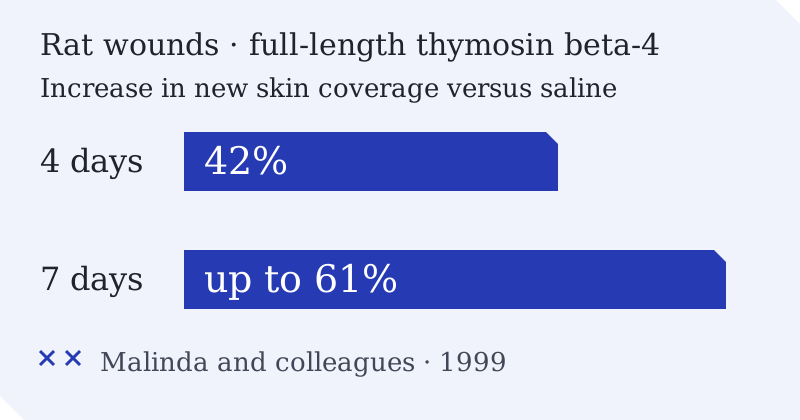
Nearly every headline finding people attribute to "TB-500" was measured on the full protein. The +61% re-epithelialization in rat wounds, the cardiac survival signaling, the stroke dose-response, the well-tolerated Phase 1 to 1260 mg — all full-length thymosin beta-4 [3][2][4][6]. This site reports those findings because they are real and they ground the rationale for studying the fragment. But it flags the substitution every time, because marketing routinely lends the protein's data to the seven-mer as if they were interchangeable. They have not been shown to be. For the mechanistic detail, see the actin-sequestration mechanism; for the dealt lens of this site, TB-500 angiogenesis research.

The dealt lens: angiogenesis, which cuts both ways

This reading is angled toward angiogenesis — the formation of new blood vessels from existing vasculature, and one of the clearest things thymosin beta-4 is reported to drive. Thymosin beta-4 promotes endothelial cell migration and tube formation [7], and in vitro it induced vascular endothelial growth factor (VEGF) in a hypoxia-inducible-factor-1α-dependent manner — a molecular route to its pro-angiogenic effect [8]. New vessels feed wound repair; that is the constructive reading.

The same activity is the basis of the caution. Thymosin beta-4 is overexpressed in several cancers and implicated in metastasis and tumor angiogenesis, so the pro-migratory, pro-angiogenic properties that aid repair could in principle support tumor progression [5]. The diagonal that builds the vessel is the diagonal that warns. Whether the fragment carries that risk in humans is not established — but the signal is why caution is the honest register here, not an afterthought. The full treatment is on the TB-500 angiogenesis research page, alongside the tumor and angiogenesis safety signal.

Where the evidence stops

There are no completed controlled clinical trials of the TB-500 heptapeptide for any indication [5]. The human clinical status of thymosin beta-4 is limited to the parent protein: a randomized, placebo-controlled Phase 1 safety and pharmacokinetic study (intravenous, healthy volunteers, well tolerated to 1260 mg) and topical ophthalmic thymosin beta-4 (RGN-259) dry-eye trials [6]. A 2026 narrative review listing TB-500 and BPC-157 among unapproved peptides concluded that many show favorable tissue-repair outcomes in animal models but that rigorous human safety data are scarce, with potential for serious harm, and that such compounds operate largely outside regulatory oversight [13]. The two are chemically unrelated, a point worth keeping straight — see TB-500 vs BPC-157.

TB-500 is not an FDA-approved drug, and the FDA placed the fragment in a 503A compounding category flagged for significant safety risks; it is also prohibited in sport by the World Anti-Doping Agency. Those facts are set out in full on TB-500 legal status and 503A access. The rest of this site sorts what TB-500 is studied for, dosing in the research literature, and the study references and citations that back every number above.

What is TB-500?

TB-500 is the synthetic N-acetylated heptapeptide Ac-LKKTETQ, corresponding to residues 17–23 — the actin-binding motif — of the 43-amino-acid protein thymosin beta-4 [1]. It has a molecular weight near 889 Da (formula C38H68N10O14) and is supplied as a research and veterinary peptide [5]. The single most important caveat is that most published efficacy data come from the full-length protein, not this seven-residue fragment [5].

What does TB-500 stand for and what does TB stand for in TB-500?

"TB" references thymosin beta-4, the parent protein; "TB-500" is a research and veterinary designation for the synthetic Ac-LKKTETQ fragment of that protein [5]. It is not an abbreviation for a tuberculosis compound. The name points back to thymosin beta-4 and the LKKTETQ stretch — residues 17–23 — that forms the protein's actin-binding core [1]. The endogenous parent is released by platelets and macrophages at sites of injury, which is part of why a fragment of it drew interest as a repair agent in the first place [5].