The dealt lens
TB-500 Angiogenesis Research: Endothelial Migration and Vascularization
The clearest thing thymosin beta-4 is reported to do — and the same activity behind the safety signal this site keeps in plain view.
TB-500 angiogenesis research: the established route
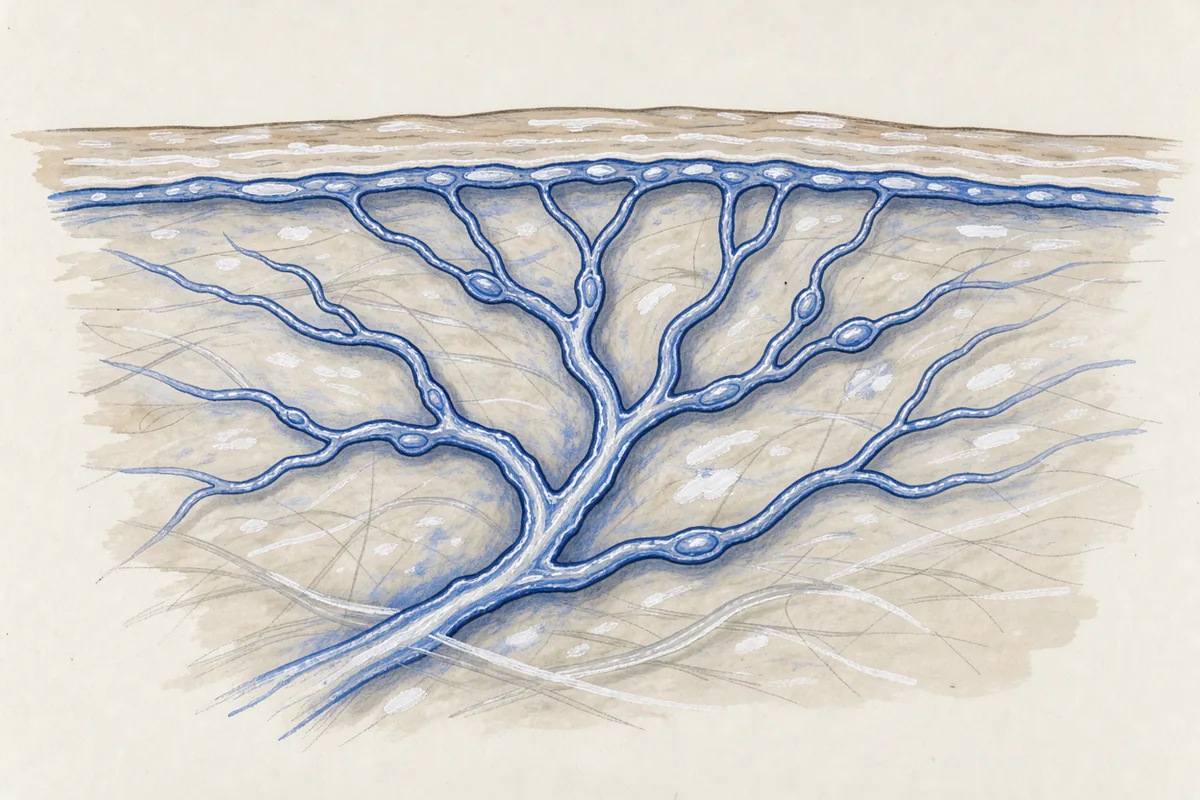
TB-500 angiogenesis research rests on the parent protein. Thymosin beta-4 promotes angiogenesis — the formation of new blood vessels from existing vasculature — through endothelial cell migration and tube formation, the modes of action a dedicated review laid out as the protein's pro-vascularization repertoire [7]. The molecular handle is well defined: thymosin beta-4 induced expression of vascular endothelial growth factor (VEGF) in a hypoxia-inducible-factor-1α-dependent manner, giving a HIF-1α → VEGF route to the pro-angiogenic effect [8].
Angiogenesis is also why the molecule reads as a wound-repair agent at all. New vessels supply a healing bed; in the rat full-thickness wound model, the +42% (day 4) and +61% (day 7) re-epithelialization gains arrived alongside increased angiogenesis and collagen deposition [3]. Engineered delivery now leans on the same property: a 2021 self-assembling-peptide system released thymosin beta-4 to drive cardiac repair with an angiogenic component [9], and a 2025 thymosin-beta-4-exosome-loaded hemostatic, antibacterial hydrogel improved vascularized wound repair by coupling the protein's angiogenic activity to wound closure [14]. These are full-length-protein and delivery-system findings — not fragment-in-human results.
Does TB-500 promote angiogenesis and is that a safety concern?
Thymosin beta-4 is reported to drive endothelial migration and new-vessel formation, and yes — the same pro-angiogenic activity is exactly why a tumor/angiogenesis safety signal is taken seriously. Repair and tumor support are not opposite mechanisms; they are the same mechanism pointed at different tissue. The protein is overexpressed in several cancers and implicated in metastasis and tumor angiogenesis [5], so caution here is structural, not decorative.
Does TB-500 increase VEGF and new blood vessel formation?
In vitro, thymosin beta-4 induced VEGF expression in a HIF-1α-dependent manner — a defined molecular route to its reported pro-angiogenic effects [8]. VEGF is the principal driver of endothelial sprouting, so upregulating it links the protein's actin-and-migration biology to actual new-vessel formation. Reviews describe the downstream result as enhanced endothelial migration and tube formation, and frame angiogenesis as one of the protein's core therapeutic-potential modes [7]. Whether the seven-mer reproduces this VEGF induction at research doses is not established.
From actin to vessel: how the mechanism connects
The angiogenesis story is not separate from the actin story — it grows out of it. Thymosin beta-4's core job is sequestering monomeric G-actin one-to-one to regulate the cytoskeleton [1], and cytoskeletal remodeling is exactly what an endothelial cell must do to migrate and form a tube. The protein's reported angiogenic repertoire — endothelial migration and tube formation — is the cytoskeletal mechanism expressed in vascular tissue [7]. Layered on top is the signaling arm: the HIF-1α-dependent induction of VEGF gives the cell a chemical driver for sprouting to match the mechanical capacity for movement [8]. One molecule, two levers on the same process.
That integration is why the parent protein reads as a wound-repair agent rather than a single-pathway drug. A consolidating review described thymosin beta-4 as binding actin, mobilizing cells, limiting apoptosis and inflammation, reducing scar-forming myofibroblasts, and promoting angiogenesis — a coordinated repair program, not an isolated vascular effect [5][12]. The fragment carries the actin-binding core of that program; whether it carries the angiogenic and signaling arms at research doses is unproven.
What the delivery-system studies add
Recent work leans on the angiogenic property by engineering where and how the protein is released. A 2021 study showed thymosin beta-4 released from a functionalized self-assembling peptide activated cardiac repair processes with an explicit angiogenic component — local delivery rather than systemic dosing [9]. A 2025 study loaded thymosin beta-4 into a hemostatic, antibacterial hydrogel via exosomes and improved vascularized wound repair, coupling the protein's angiogenic activity directly to wound closure [14].
These are worth reading as a signal about the field's direction: the interest is increasingly in controlled local delivery of the full-length protein, not in systemic injection of the bare fragment. Neither study is a human efficacy trial, and neither tested the Ac-LKKTETQ seven-mer on its own. They sharpen the angiogenesis rationale while leaving the fragment-in-human question exactly where the rest of the literature leaves it — open. For the broader evidence picture behind these vascular findings, see what TB-500 is studied for and the full study references and citations.
The tumor and angiogenesis safety signal
The honest reading of this page is that its strength is its risk. Thymosin beta-4 is overexpressed in several cancers, including pancreatic and colorectal, and is implicated in metastasis and tumor angiogenesis; the pro-migratory, pro-angiogenic properties that accelerate wound repair could, in principle, support tumor progression [5]. A 2026 narrative review of unapproved musculoskeletal-repair peptides placed TB-500 and thymosin beta-4 in exactly this frame: favorable animal-model repair outcomes, scarce rigorous human safety data, potential for serious harm, and operation largely outside regulatory oversight [13].
What is not known is whether the isolated Ac-LKKTETQ fragment carries this risk in humans at the amounts used in peptide research. There is no controlled human trial to answer it [5]. The signal is theoretical for the fragment — but it is grounded in the protein's documented cancer biology, which is why this site states it on the same page that reports the angiogenesis findings, not buried elsewhere. The diagonal that builds the vessel is the diagonal that warns; both belong on the page that celebrates the mechanism.